

Where rose fields once shaped the landscape, fragrances and flavours are now created for customers all over the world. Leipzig-Miltitz is far more than a production site: it is where an entire industry has its roots. In 1879, Schimmel & Co. set up the industry’s first industrial research laboratory and, together with the future Nobel laureate Otto Wallach, developed testing standards by which essential oils were traded worldwide. In the GDR years, the site was the heart of the cosmetics and flavour industry. Since 1993, Bell has carried this tradition forward through technology, innovation and research, in close partnership with Leipzig University and backed by the knowledge held in the Schimmel Library’s 30,000 or so volumes. Discover almost 200 years of fragrance and flavour across three eras.
From rose fields near Leipzig to a global presence
Company Milestones
Bell’s roots reach back to the very beginnings of an entire industry. From the founding of Schimmel & Co. in 1829, through the decades in the GDR, to Bell’s acquisition of the site in 1993 and beyond, we have brought together the key milestones for you.
1829-1948
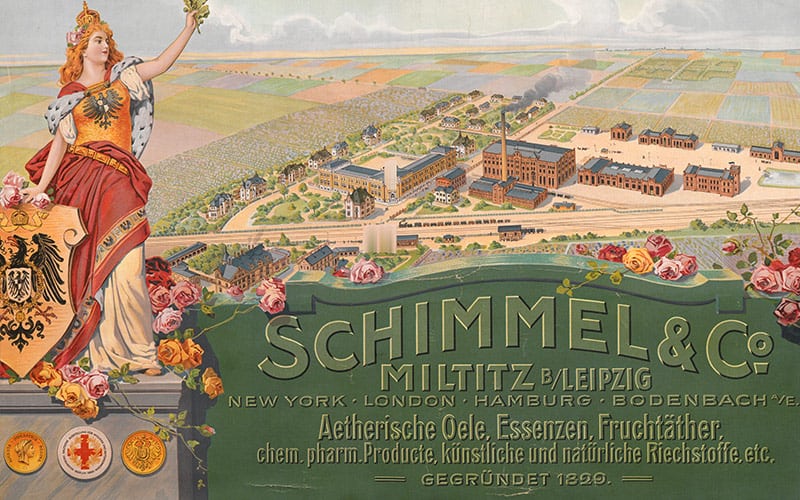
Pioneers of an Industry
It all began with trade. In 1829, a druggist and a pharmacist opened a business in Leipzig selling medicinal drugs. Hermann Traugott Fritzsche paved the way into industry. From 1854 onwards, he turned the company into a producer of essential oils, relying on science rather than secret recipes. With the industry’s first industrial research laboratory and in close collaboration with the future Nobel laureate Otto Wallach, Schimmel & Co. developed processes and testing standards that became the benchmark worldwide. In 1901, the company moved into its new works amid the rose fields of Miltitz. Expropriation in 1948 brought the Fritzsche family’s era to an end, but the site’s capacity for innovation endured.
Establishment of the Spahn Büttner company by Leipzig chemists Ernst Ludwig Spahn and Gottlob Eduard Büttner
Renaming to “Spahn Schimmel” with the joining of Friedrich Edmund Louis Schimmel
Acquisition of the subsequently renamed “Schimmel & Co.” company by Hermann Traugott Fritzsche
Foundation of the Fritzsche, Schimmel & Co. branch in New York
Publication of initial trade reports, later referred to as Schimmel Reports
Establishment of the first chemical test laboratory for essential oils
Extraction of the first rose oil in Miltitz
Construction of the extensive factory complex with adjoining housing estate in Miltitz
Nobel Prize for Prof Dr Otto Wallach, then working at the company
Merger with Leipzig company E. Sachsse & Co. to form a family-owned company
100-year company anniversary
Expropriation by the Soviet occupying power
1956 – 1992
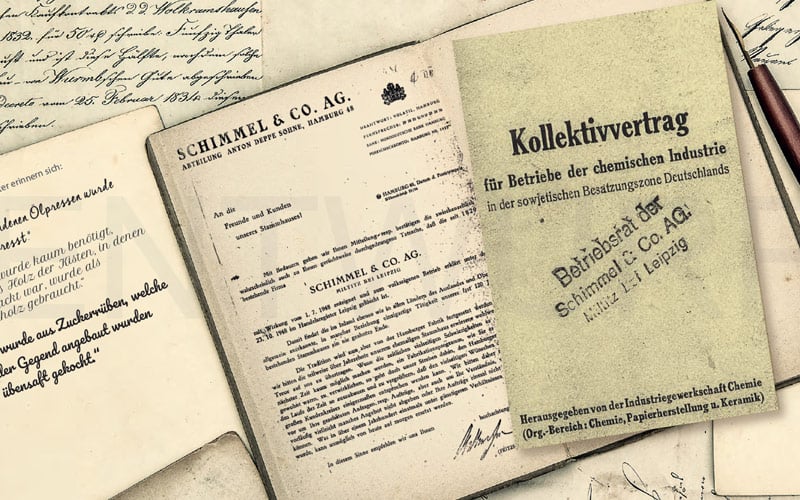
The Heart of an Industry
Almost every shampoo, cream and aftershave in the GDR carried a fragrance from Leipzig. The Kombinat Miltitz brought together nearly all of the country’s cosmetics manufacturers. In the 1980s, it supplied large parts of the soap, perfume and detergent industries, as well as much of the flavour industry, with aroma chemicals and flavourings. The close ties to science remained: the works and Leipzig University researched new processes together. Where shortages of foreign currency and raw materials set limits, the chemists in Miltitz developed solutions of their own. When the end of the Soviet Union swept away its markets, the site still had the expertise it had built up over decades.
On the other side of the Atlantic, a company with a history all its own had been making a name for itself. Founded in Chicago in 1912 by flavour chemist William M. Bell, the William M. Bell Company supplied ice cream parlours, grocery stores and soda fountains with its flavours. In 1968, Edward N. Heinz acquired what was then a small business with just two employees. Through targeted acquisitions, he built it into a broad-based manufacturer of flavours and fragrances, trading as Bell Flavors & Fragrances since 1979.
1993 – today
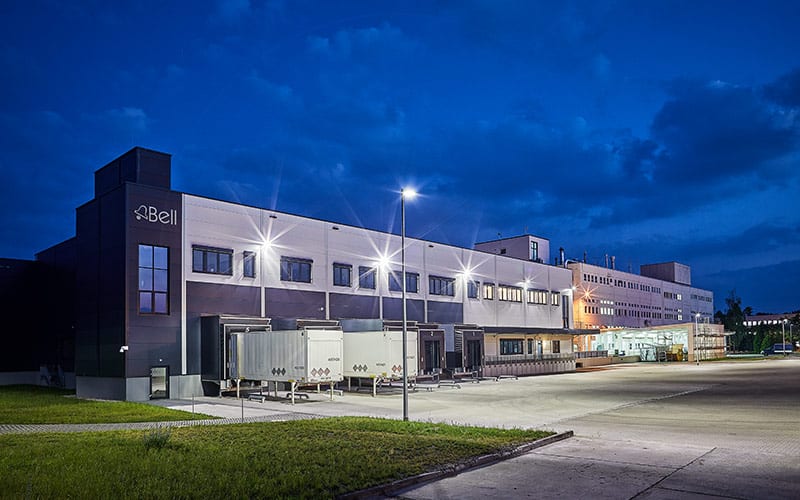
Global Network
In June 1993, a new chapter began at this historic site with 65 employees. Targeted investment transformed the former Schimmel works into an internationally active manufacturer of fragrances and flavours. The plant was modernised, and research and development expanded on the existing expertise. The Schimmel Library, with around 30,000 volumes, was restored and made accessible once again.
Today, around 340 people work at one of Europe’s large and modern production sites. The logistics centre completed in 2017 is one of Bell’s largest single investments in Germany. The site remains closely tied to Leipzig, whether through joint research with the university, which has long since extended to artificial intelligence, or through the “Leipzig Duft”, a fragrance created for its home city.
From Leipzig, Bell is connected through subsidiaries from the United Kingdom and Dubai to India and Vietnam, carrying the tradition of Schimmel & Co. into the future.
Acquisition by Bell Flavors & Fragrances Inc (more on the history of Bell in the US).
Relocation of administration and research from the old factory to the research building
Resumption of trade relations with Russia, the Commonwealth of Independent States and Vietnam
Introduction of the XAL business software
Inauguration of the originally reconstructed Schimmel Library
Establishment of a subsidiary in Moscow, Russia
Commissioning of the first pastillation plant and expansion of fragrance production
Opening of a sales office in Pszczyna, Poland
Establishment of a subsidiary in France
Opening of a sales office in Kiev, Ukraine
Foundation of a subsidiary in the UK
Expansion of flavour production
Modernisation of the research building
Opening of sales offices in Hanoi and Ho Chi Minh City, Vietnam
Introduction of a document management system (DMS)
Expansion of the site to 200,000 square metres
Foundation of a subsidiary and opening of a sales office in Dubai, United Arab Emirates
Acquisition of a company in India
Modernisation of the synthesis and distillation facilities
Introduction of the ERP system (AX)
Inauguration of the new logistics centre